Sunday, May 8, 2011

Easter Break-Day 6

County Donegal

We stayed outside of Creeslough in county Donegal for three nights. The country side of this county is very different then the rest of Ireland. It is a very barren, stark, rugged land with sharp coastlines. It has a beauty of it's own.
The Glenveagh National Park and Castle look like an oasis in the middle of this barren land.
The Glenveagh castle was completed in 1873 by John George Adair who used it as his hunting estate. After he passed away his widow transformed the gardens into adding more exotic species and added rooms to the castle. Kingsley Porter bought the estate later and then soon afterward disappeared. Many believed he drowned. The last owner was a Philadelphia millionaire Henry McIlhenny and he then handed the estate over to the Irish nation in 1981.
The view from the heated swimming pool which Greta Garbo was said to have visited often.
The lake side garden and pool.
We took the castle tour which took us around each of the rooms and saw the rare furnishings and paintings. We were in a group of about 20 or so and Elise just didn't think we were seeing the best of things so she walked right up to the tour guide and took her hand. After that Elise became the tour guide's assistant through the rest of the tour and never left her side. I guess you could say she isn't shy.
There was so much beauty in this place and the weather was incredible. It was one of those glorious days you never want to forget.

Friday, May 6, 2011

Easter Break-Day 5

Cliffs of Moher and Onward to County Donegal

The Cliffs of Moher are located on the west coast of Ireland in the county of Clare. They stretch for five miles and rise 650 feet above the Atlantic Ocean. We stopped for a visit on our way to Donegal. The visitors center is inside the hill and had some fun 3-D films of flying over the cliffs.
Just in case you forget...Actually, I guess many have misjudge the edge of the cliffs and have tumbled over!

The O'Brien's Tower was built in 1853 and marks the highest point of the cliffs. The view from this point was breathtaking.


I guess it's normal to not heed the warning signs?

After our visit to the cliffs we headed to our little cottage in Dongal. It was a five and half hour car ride but well worth the drive.


Wednesday, May 4, 2011

Easter Break-Day 4

Easter Sunday-Cork to Shannon

During our stay in Cork we were at a Radisson hotel. On the evening of the 23rd we were meet with a notecard with a clue on it hanging from our door. The hotel staff had put together an Easter egg hunt for the kids in our hotel room. The kids thought this was the greatest and loved finding the 6 clues and were rewarded with four large chocolate eggs hiding in the lock box. The next morning we headed out early for our unorthodox Easter Sunday experiences. We started the day at the Swiss Cottage.

The Swiss cottage was built in the early 1800s for Richard Butler, the first Earl of Glengall. The cottage was built with the intention of blending in with the surrounding environment. So there is nothing about the cottage that is symmetrical. Every door and window has it's own distinct measurement and no two are alike. You were made to feel as if you were living inside a tree. We had a great time exploring.
The Rock of Cashel
Here is where the ancient kings of Munster reigned in 300-1100 A.D. This was also a place of great tribal wars as kings fought for the great fortress. In 1101 Murtagh O'Brien gave the Rock to the Church. This provided a great ecclesiaastical center for the growing Christian church.
This piece of wall fell off during a massive storm after being weakened by cannon fire in one of the many battles fought here.
Graveyard and Round tower. The round tower was the first stone structure built on the Rock after the Church took it over. It was used as a bell tower and lookout post. The monks would use this as a place to store their precious sacramental treasures.
St. Patrick is said to have baptized King Aengus at the Rock of Cashel. The 12th century cross was carved to celebrate the handing over of the Rock to the Church 650 years after St. Patrick's visit. This is just a replica of what once stood there. Over the years the wind and the rain have eroded the original and so they have moved it inside to the museum for protection. Many tourist can be seen trying to hug this cross as the tour guide explains an Irish legend of believing that if your arms could touch while encircling the cross you will never suffer from a hangover. I think I might have a better way.
Inside the cathedral.
From the grave yard there is a great view over the Plain of Tipperary, once covered by giant oak trees. In view is the Hore Abby. This abby was named for the Cistercian monks who wore simple gray robes, the same color as hoarfrost. We walked around the ruins and found it very peaceful and a reprieve from the overwhelming amount of tourist at the Rock.

After our tours we made a couple hours drive to the Shannon area where we stayed at a golf resort village. It came as a pleasant surprise to be staying in a town house where we had two levels, a full size kitchen, two bathrooms, laundry facilities, and one of the largest places we have stayed in yet since we have been to Ireland.

Tuesday, May 3, 2011

Easter Break-Day 3


Muckross House and Traditional Farms

After our morning swim we headed west to the Muckross House where we explored the gardens and learned a bit about the Victorian period. Queen Victoria stayed in the bottom floor bedroom for three nights. The gardens were amazing.
You could travel in style after you bargained out the right price for a carriage ride. We decided to use our good feet instead.
A great view of some of the garden.
The Muckross House from the side.
A couple of meters away is the entrance to the Muckross Traditional Farms. There are six different working farms on a walking route dating from the 1930s. As you walk along the path you stop off at each of these little farms and there is a farmhouse usually with animals and a farmer or wife to let you know a bit about life at that time. We watched as they baked soda bread over a peat fire and showed us where the kids would sleep and what chores they would do.
Real live piggy wiggy among many other of the farm animals here. We saw mules, donkeys, chickens, dogs, pups, cats, peahens, cows, and of course lots of sheep.
The boys enjoying the farm life? At least they enjoyed looking at it...
Real live Irish Wolf Hounds and I was told these were just pups!
We moved onward to our drive around the Dingle Peninsula! This was my favorite part of the trip and probably one of the prettiest places on earth. I kept telling Cam to pull over so we could take the same picture over and over. Here are a few of them...
Beehive Huts. They look like stone igloos and are surrounded by a stone wall in the middle of a pasture filled with sheep. They are around 4,000 years old and somehow have withheld their form. Impressive craftsmanship. These provided shelter for families and the hard life these original Irishmen endured.
One of our favorite pictures. This is taken from the western most point of Europe.

One of the many vacant stone farmhouses left after the terrible potato blight of 1845 that devastated the population. There once was 40,000 people living on the peninsula and today there are 10,000.
More of the beauty of the area in which photos just don't do justice.
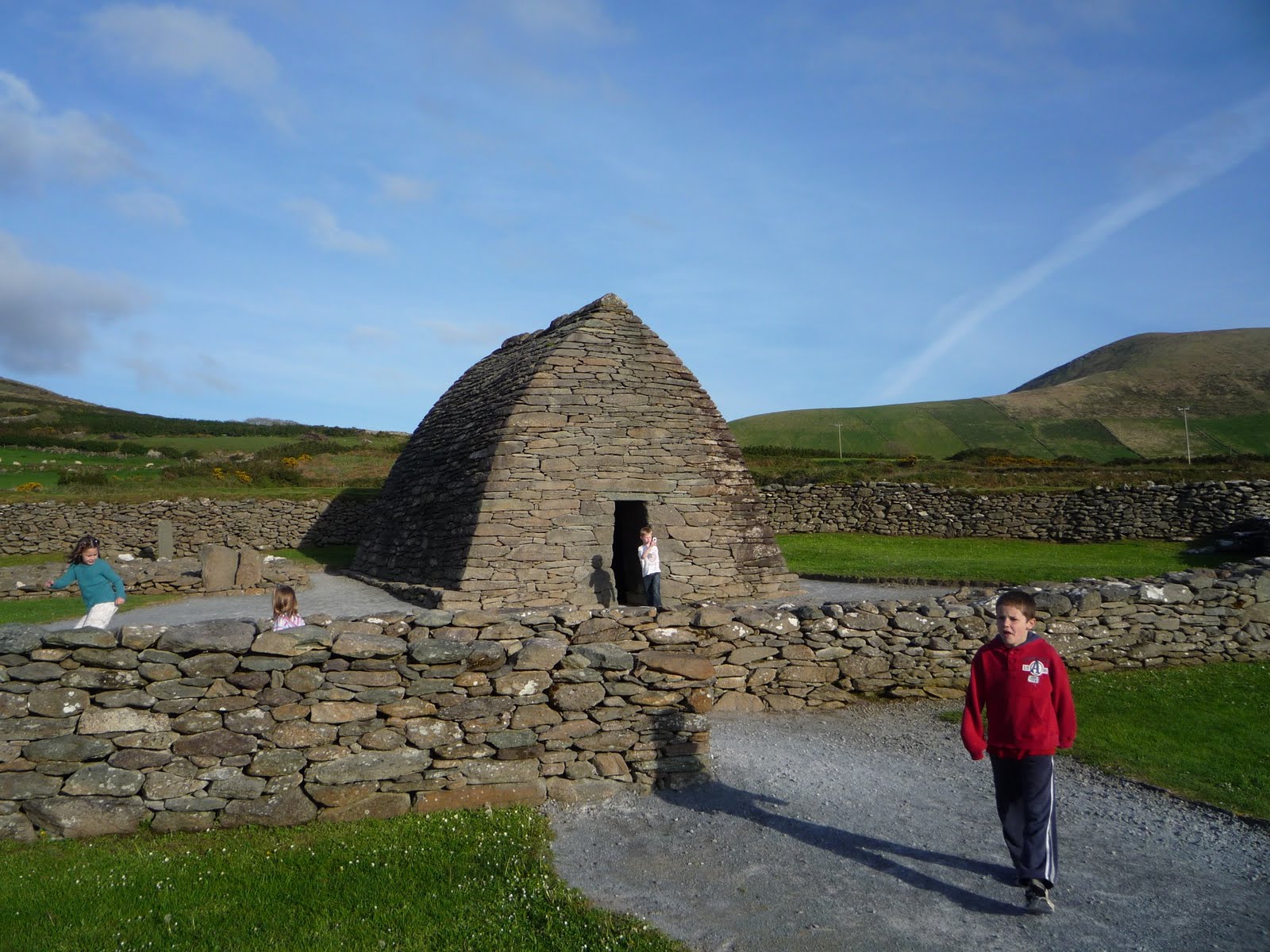
We stopped off at the Gallarus Oratory built about 1,300 years ago. This is one of Ireland's best preserved early Christian churches. This is a view from the Oratory.
The church is still waterproof with the finely fitted stone walls. The door is facing west to allow the the evening light into the building. The small window facing east allows the morning light within.
An early Christian cross on the grounds.
It was a beautiful and peaceful way to end our breathtaking tour around the peninsula.

Easter Break-Day 2

Ring of Kerry

On our drive to the Ring of Kerry we passed this craft shop with the Quinlan name on it. Pretty cool to see a shop with your last name on it. Who knows maybe it was a distant relative?
The gorse was in full bloom and covered most of the hillsides which I thought added brightness and beauty. Farmers here would disagree as they are a nuisance, hard to control, and very prickly.

Our first ring fort was a stop at the Staigue Fort. The fort was built sometime between 500 B.C. and A.D. 300. They didn't use any type of mortar so it's amazing to see how they meticulously cut the rocks to fit together. There are different thoughts as to what these forts were used for. Some believe that the people who built them used them in times of tribal war. Or that herders used these forts to keep their cattle in to keep them safe.
Some believe that they were used as a type of amphitheater where tribes would meet for important meetings or ceremonies. It was a striking image to walk through those thick stone walls and stand inside and realize that we were standing in something possibly made before the time of Christ.
We stopped at several scenic pull outs for the amazing views of the Atlantic Ocean against the cliffs of the Kerry Coastline.
We stopped at the Derrynane House where Daniel O'Connel (Ireland's most influential pre-independance politician who fought for the rights and equality for the Catholics) lived. It was a pretty estate and was surrounded by coastal lands that are now a national historic park.


The kids played on the beaches and rocks surrounding the estate and didn't want to leave.

Some views of the Ring of Kerry.